
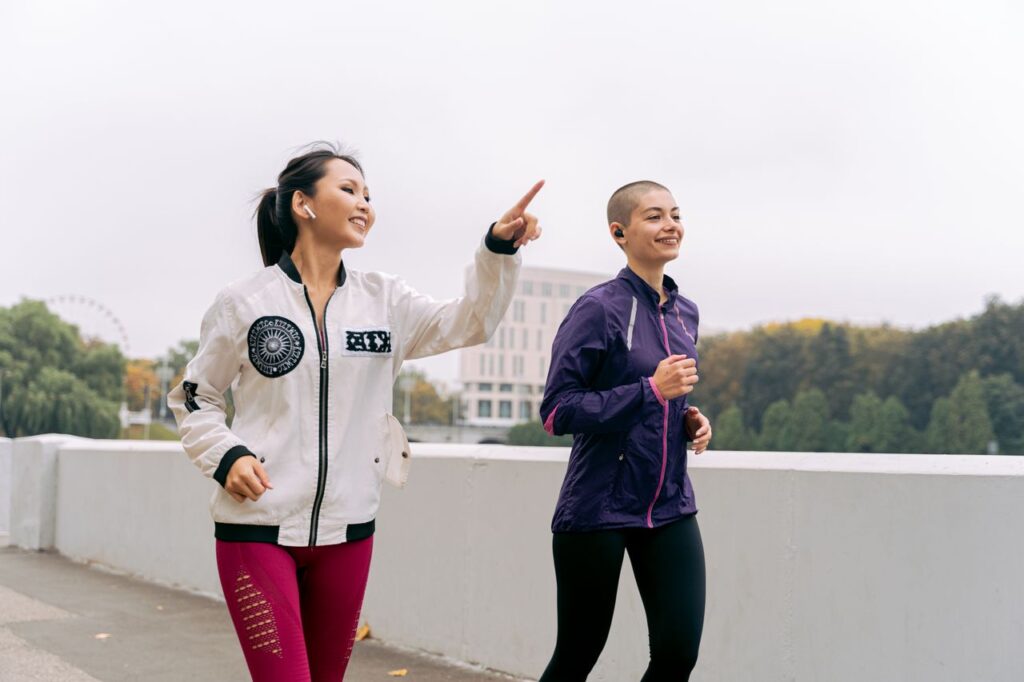
Over the past few years, “cycle syncing” has become one of the biggest trends in women’s endurance sport. Apps promise to tell you exactly when to hammer your intervals and when to back off, based on which phase of your menstrual cycle you’re in. It’s an appealing idea: finally, training built around female physiology instead of research done almost exclusively on men. But when you look closely at the science behind these claims, the picture is far messier and in some ways, more useful than the apps suggest.
The theory: four phases, two hormones
A “textbook” 28-day cycle is usually split into four phases: menstruation, the follicular phase, ovulation, and the luteal phase. Through this cycle, oestrogen and progesterone rise and fall and both hormones influence far more than reproduction they affect substrate metabolism (how much you rely on carbohydrate versus fat), core temperature, fluid balance and connective tissue stiffness.
From this, a popular training theory emerged: push your hardest sessions in the follicular phase, when oestrogen is rising and you may feel stronger and recover faster and dial back intensity in the luteal phase, when progesterone dominates and perceived effort, resting heart rate and body temperature tend to be slightly higher.
It’s a logical hypothesis. The question is whether it holds up.
What the research actually shows
The strongest evidence we have comes from a 2020 systematic review and meta-analysis by McNulty and colleagues, pooling 78 studies on menstrual cycle phase and exercise performance. The headline finding: the effect of cycle phase on performance is trivial overall, with only a small dip detected in the very early follicular phase (during menstruation itself) compared with the rest of the cycle and even that effect was rated as low-quality evidence (McNulty et al., 2020, Sports Medicine). A companion meta-analysis by the same group found no meaningful average effect of oral contraceptive use on performance either (Elliott-Sale et al., 2020, Sports Medicine).
More recent work has tested the theory directly rather than just observing it. In a 2024 randomised controlled trial, one group of runners trained their hard sessions in the follicular phase and easy sessions in the luteal phase, while a control group did the exact opposite same total training load, different timing. After eight weeks, both groups improved their VO₂max and ventilatory thresholds by a similar amount, with no advantage for the “cycle-matched” group (Kubica, Ketelhut & Nigg, 2024, European Journal of Applied Physiology).
Why does the picture painted by wellness apps feel so much more certain than the actual research? Partly because a lot of the older underlying studies have real methodological problems: small sample sizes, self-reported cycle phase instead of hormone testing and huge natural variation between individuals and even between an individual’s own cycles. A widely-cited 2021 paper by Elliott-Sale and colleagues lays out exactly what rigorous research in this area needs to look like and how much existing literature falls short of it (Elliott-Sale et al., 2021, Sports Medicine). In short: at a population level, there is no strong case for rebuilding your training plan around a fixed cycle-phase template.
Connective tissue and injury risk: still an open question
One area that gets a lot of attention is whether hormonal fluctuations affect ligament laxity and injury risk, particularly around the knee. A 2023 systematic review looking specifically at ACL injury risk surrogates across the cycle concluded that the evidence is currently inconclusive. Some studies suggest slightly higher knee laxity in the mid-luteal phase, others find no difference and overall study quality was rated very low (Dos’Santos et al., 2023, PLOS ONE). Worth keeping an eye on as the research matures, but not yet a reason to change how you train.
The one area where the evidence is strong: don’t ignore a missing period
Here’s the part of this topic that deserves far more attention than cycle-phase workout timing: if your period becomes irregular or stops altogether while you’re training seriously, that is not a sign you’re “lean and fit” it’s a warning sign.
The 2023 IOC consensus statement on Relative Energy Deficiency in Sport (REDs) is the most authoritative summary of this issue. It describes how insufficient fuelling relative to training load even without deliberate restriction disrupts hormone production, which shows up first as menstrual dysfunction and over time increases the risk of stress fractures, impaired bone density, illness and declining performance (Mountjoy et al., 2023, British Journal of Sports Medicine). Unlike the cycle-syncing debate, this is well-established, high-consensus science and it applies just as much to a recreational runner building up marathon mileage as it does to an elite athlete.
What this means for your training, practically:
- Don’t force a rigid cycle-based template onto your training plan. The population-level evidence for it is weak and a generic app-based rule may not match your own pattern at all.
- Track your own data instead of a generic rule. Over two or three cycles, note your energy, sleep, RPE for the same sessions and any symptoms. If you notice a genuine, repeatable pattern, that’s worth discussing with your coach. Your own data beats an average from a meta-analysis of other people.
- Be aware of the temperature and fluid-balance shift in the luteal phase. Core temperature and resting heart rate run slightly higher in this phase for many women, which is worth factoring in on hot days. See our earlier articles on training in the heat.
- Treat a missing or irregular period as a conversation, not a footnote. It’s one of the earliest and clearest signals that your fuelling isn’t matching your training load. Flag it to your coach and if it persists, a doctor.
- Fuel adequately, especially around your long runs and higher-volume weeks. This matters more for long-term health and performance than the timing of any single session.
The bigger picture
Cycle-based training makes for a compelling headline, but the strongest science in this space isn’t about optimising which week you do your intervals. It’s about making sure your training and your fuelling are actually in balance in the first place. That’s a very “SRS” conclusion, really: individual patterns, tracked honestly and discussed with your coach, will always tell you more than a generic rule applied to everyone.
References
- McNulty, K.L., Elliott-Sale, K.J., Dolan, E., et al. (2020). The Effects of Menstrual Cycle Phase on Exercise Performance in Eumenorrheic Women: A Systematic Review and Meta-Analysis. Sports Medicine, 50(10), 1813–1827. https://link.springer.com/article/10.1007/s40279-020-01319-3
- Elliott-Sale, K.J., McNulty, K.L., Ansdell, P., et al. (2020). The Effects of Oral Contraceptives on Exercise Performance in Women: A Systematic Review and Meta-analysis. Sports Medicine, 50. https://pubmed.ncbi.nlm.nih.gov/32666247/
- Kubica, C., Ketelhut, S., & Nigg, C.R. (2024). Polarized running training adapted to versus contrary to the menstrual cycle phases has similar effects on endurance performance and cardiovascular parameters. European Journal of Applied Physiology, 124(11), 3433–3444. https://link.springer.com/article/10.1007/s00421-024-05545-9
- Elliott-Sale, K.J., Minahan, C.L., de Jonge, X.A.K.J., et al. (2021). Methodological Considerations for Studies in Sport and Exercise Science with Women as Participants: A Working Guide for Standards of Practice for Research on Women. Sports Medicine, 51(5), 843–861. https://pubmed.ncbi.nlm.nih.gov/33725341/
- Dos’Santos, T., Stebbings, G.K., Morse, C., Shashidharan, M., Daniels, K.A.J., & Sanderson, A. (2023). Effects of the menstrual cycle phase on anterior cruciate ligament neuromuscular and biomechanical injury risk surrogates in eumenorrheic and naturally menstruating women: A systematic review. PLOS ONE, 18(1), e0280800. https://journals.plos.org/plosone/article?id=10.1371/journal.pone.0280800
- Mountjoy, M., Ackerman, K.E., Bailey, D.M., et al. (2023). 2023 International Olympic Committee’s (IOC) consensus statement on Relative Energy Deficiency in Sport (REDs). British Journal of Sports Medicine, 57, 1073–1097. https://www.olympics.com/ioc/news/ioc-publishes-new-consensus-statement-on-relative-energy-deficiency-in-sport-reds-to-protect-athlete-health