
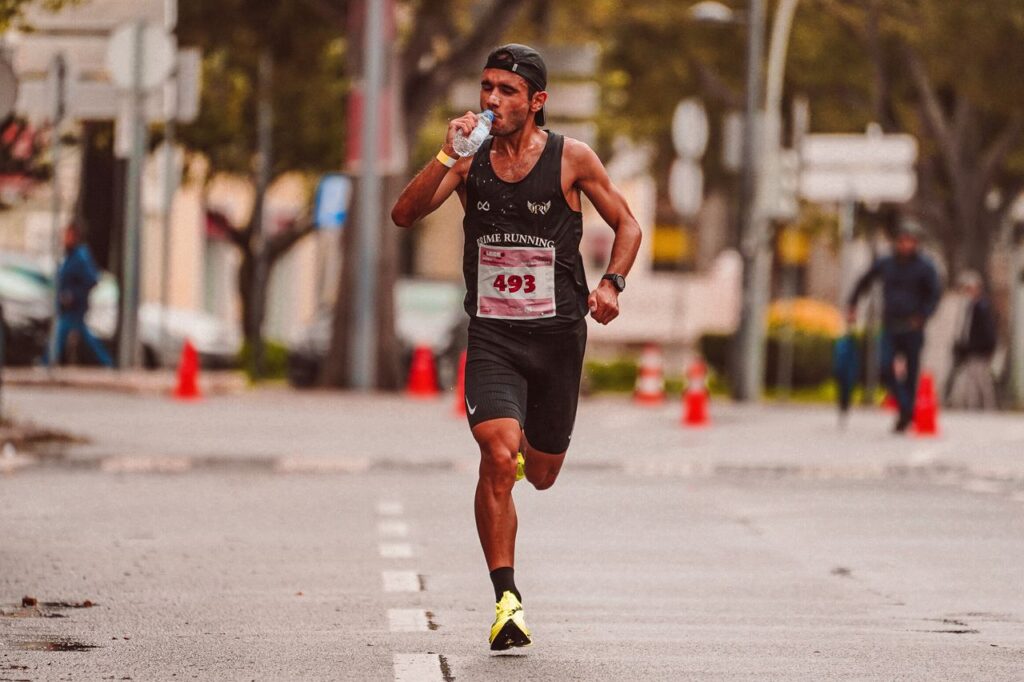
A bloated feeling, side stitches, nausea or an unplanned toilet stop: almost every runner has experienced it at some point. Research shows that gastrointestinal (GI) complaints during running are common, with reported prevalence ranging from roughly 30% to over 90% of participants, depending on how strictly “symptom” is defined and which distance is studied (Peters et al., 1999; de Oliveira & Burini, 2014). Among marathon runners specifically, a substantial share report moderate to severe symptoms both in the days before and during the race (Pugh et al., 2018).
The good news: just like muscles, tendons and fascia, the gastrointestinal tract can be trained too. This principle is known as “train the gut” and is now well supported by sports science research.
Why do runners get gut problems?
Two main causes are usually at play, often together:
1. Mechanical stress. The repeated vertical impact of running literally shakes the digestive tract. This is one reason runners tend to report more GI complaints than, for example, cyclists, whose torso experiences far less up-and-down movement (blog.runningcoach.me, 2026).
2. Insufficient adaptation to sports nutrition. During exercise, blood flow is redirected away from the gut toward the working muscles, which already puts digestion under strain. If large amounts of carbohydrate and fluid are then introduced that the body isn’t used to, a mismatch arises between what is offered and what the gut can actually absorb (Jeukendrup, 2017).
The science behind “train the gut”
The GI tract turns out to be remarkably adaptable, on at least three levels:
Gastric emptying. The rate at which the stomach empties into the small intestine can itself be trained. Early research already showed that a few days of daily glucose supplementation could speed up gastric emptying in healthy subjects (Cunningham et al., 1991).
Intestinal transporters. Carbohydrates are absorbed from the small intestine via specific transport proteins: SGLT1 for glucose and GLUT5 for fructose. Cox and colleagues showed that four weeks of training with high carbohydrate availability measurably increased the oxidation of carbohydrate consumed during exercise, suggesting an increase in intestinal transport capacity (Cox et al., 2010). In his widely cited review, Jeukendrup (2017) concludes that chronic exposure to higher carbohydrate intake enables the body to absorb and oxidize more carbohydrate during exercise.
Subjective tolerance. Costa and colleagues found that just two weeks of repeated “gut-challenge” during exercise (daily training with a fixed amount of sports nutrition) was enough to reduce GI symptoms and improve running performance in a subsequent test (Costa et al., 2017).
Because glucose absorption via SGLT1 saturates at around 60 grams per hour, combining glucose with fructose (which uses the separate GLUT5 pathway) can further raise total absorption capacity, potentially up to 90 grams of carbohydrate per hour or more during longer efforts (Jeukendrup, 2017; Jentjens et al., 2004).
How to build it up smartly
The common thread running through the literature is: build up gradually, repeat consistently and never try anything new on race day.
- Start small. Begin with a modest amount of carbohydrate and fluid during easy long runs and increase step by step toward the amount you intend to take in during the race.
- Be consistent. Noticeable improvements in tolerance can already appear after roughly two weeks of regular practice (Costa et al., 2017), though structural adaptation of intestinal transporters requires repetition over several weeks.
- Practice under race-like conditions too. Take on sports nutrition not only during easy long runs, but also during tempo runs and long runs at race pace, when blood flow to the gut is more restricted.
- Progress toward dual-source carbohydrates. Start with a single carbohydrate source (glucose or maltodextrin) before moving on to a glucose-fructose combination, to engage both SGLT1 and GLUT5.
- Train with a fuller stomach. Training after a meal, rather than always fasted, can help improve tolerance for food intake during exercise (Jeukendrup, cited in nduranz.com).
- Don’t neglect fluid. Adequate fluid intake supports faster gastric emptying and can actually reduce, rather than worsen, stomach discomfort.
Putting it into practice
For a marathon runner aiming to take in 60–90 grams of carbohydrate per hour on race day, this means: don’t wait until the final weeks before the marathon to experiment with gels and sports drinks. Instead, build this in structurally from the base-building phase onward, during long runs and tempo sessions. This way, the gut, just like the muscles, is gradually prepared for the demands of race day.
In short
GI complaints are not inevitable, they’re often the result of an under-trained digestive system. The science is clear: just as muscles get stronger through training, the gut becomes more efficient at absorbing carbohydrate and fluid through repeated, gradually built-up exposure during training. So train your nutrition just as seriously as your legs.
References
Costa, R.J.S., Miall, A., Khoo, A., Rauch, C., Snipe, R., Camoes-Costa, V., & Gibson, P. (2017). Gut-training: The impact of two weeks repetitive gut-challenge during exercise on gastrointestinal status, glucose availability, fuel kinetics and running performance. Applied Physiology, Nutrition, and Metabolism, 42, 547–557.
Cox, G.R., Clark, S.A., Cox, A.J., Halson, S.L., Hargreaves, M., Hawley, J.A., Jeacocke, N., Snow, R.J., Yeo, W.K., & Burke, L.M. (2010). Daily training with high carbohydrate availability increases exogenous carbohydrate oxidation during endurance cycling. Journal of Applied Physiology, 109(1), 126–134.
Cunningham, K.M., Horowitz, M., & Read, N.W. (1991). The effect of short-term dietary supplementation with glucose on gastric emptying in humans. British Journal of Nutrition, 65, 15–19.
de Oliveira, E.P., & Burini, R.C. (2014). Carbohydrate-dependent, exercise-induced gastrointestinal distress. Nutrients, 6(10), 4191–4199.
Jentjens, R.L.P.G., Moseley, L., Waring, R.H., Harding, L.K., & Jeukendrup, A.E. (2004). Oxidation of combined ingestion of glucose and fructose during exercise. Journal of Applied Physiology, 96(4), 1277–1284.
Jeukendrup, A.E. (2017). Training the gut for athletes. Sports Medicine, 47(Suppl 1), 101–110.
Peters, H.P.F., Bos, M., Seebregts, L., Akkermans, L.M.A., van Berge Henegouwen, G.P., Bol, E., Mosterd, W.L., & de Vries, W.R. (1999). Gastrointestinal symptoms in runners, cyclists, and triathletes. American Journal of Gastroenterology, 94(6), 1570–1581.
Pugh, J.N., Kirk, B., Fearn, R., Morton, J.P., & Close, G.L. (2018). Prevalence, severity and potential nutritional causes of gastrointestinal symptoms during a marathon in recreational runners. Nutrients, 10(7), 811.
This article was written for the SRS knowledge platform and is intended as general sports-science background. Individual sports nutrition advice for training and racing should be discussed with your coach.