
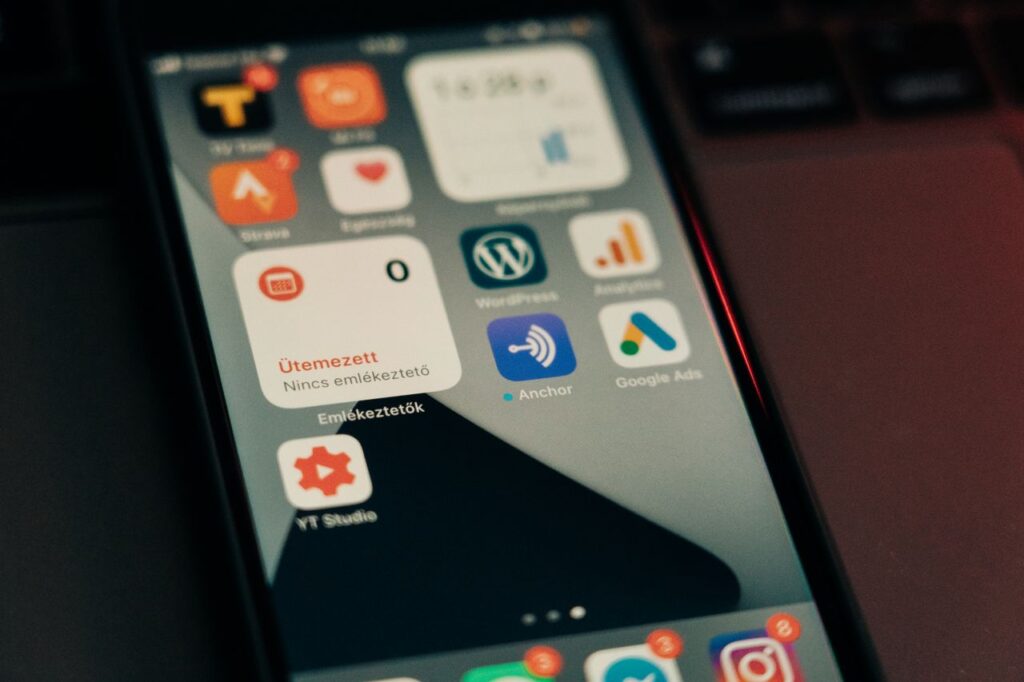
Social media addiction in runners — Symptoms & side effects
Fifteen years ago, a good long run ended when you got home, stretched and maybe told a training partner how it went. Today it often ends with a phone in hand: uploading the GPX file, writing a caption, watching the kudos and comments roll in. Running has always had a social side, but for a growing number of runners, the social media layer has quietly become the point of the run and that shift comes with real psychological costs.
This isn’t about vilifying Strava, Instagram or TikTok. Used well, these platforms build community, accountability and motivation a recent Strava industry report even found Gen Z runners deliberately trading time on Instagram and TikTok for more time on fitness apps (Sporting Goods Intelligence, 2026). The problem starts when the posting becomes more important than the running when a runner’s mood, training decisions and sense of self-worth start depending on how a workout performs online rather than how it felt in the body.
Why running and social media hook so easily
Running already produces a natural reward loop: effort, discomfort, completion, relief, pride. Social media adds a second, faster reward loop on top of it likes, kudos, comments. Researchers who study problematic social media use describe this in terms of the same core components as behavioral addiction: salience, mood modification, tolerance, withdrawal, conflict and relapse (Andreassen et al., 2016). The unpredictability of the reward you never know exactly how many kudos a run will get is precisely what makes checking the app so compelling. Layer that onto a sport built around public numbers (pace, distance, PRs) and constant self-tracking, and you get a near-perfect environment for compulsive checking behavior.
Add to that social comparison training culture is now visible 24/7, so a runner’s “normal” easy run gets compared not to their own baseline, but to a global feed of PRs and podium photos. Studies of Strava specifically describe this as a double-edged sword: the same social comparison that motivates people to train more also produces measurable anxiety and low mood, especially during injury or a dip in performance (Russell, Potts & Nelson, 2023). A separate analysis of Strava’s “kudos” mechanic found it functions as a genuine social-influence tool runners visibly train more and more intensely, in response to the social feedback they receive from others on the platform (Stragier et al., 2022).
Signs it’s tipping into a problem
Not every runner who posts training is at risk. The signs worth paying attention to are less about how much someone posts and more about what’s driving the run itself:
Checking the app compulsively before, during or immediately after a run sometimes even pausing a workout to see who’s commented. Choosing routes, times or efforts based on what will look good online rather than what the training plan actually calls for. A mood that rises and falls with kudos and comments rather than with how the session actually felt consistent with findings that upward comparisons on platforms like Instagram directly track with lower self-esteem and worse mood (Frontiers in Psychology, 2025; Verduyn et al., 2023). Real anxiety about posting a “bad” run or hiding/deleting runs that don’t meet a certain standard echoing runners’ own accounts that “if it’s not on Strava it didn’t happen” (Russell, Potts & Nelson, 2023). Comparing personal times and volume to strangers’ feeds rather than to a coach’s plan or personal history. Doomscrolling training content late at night, cutting into the sleep that recovery actually depends on. And, most tellingly: a noticeable drop in enjoyment of running itself once the phone is out of the picture.
The psychological and physical side effects
Anxiety and mood instability. When self-worth becomes tied to public metrics, ordinary bad days the ones every training block includes start to feel like failures rather than normal variation. Fear of missing out (FoMO), the anxious sense that others are having more rewarding experiences, is itself linked to lower life satisfaction and higher anxiety and depression symptoms in people with heavy social media use (Przybylski et al., 2013).
Training decisions driven by image, not physiology. Runners chasing “postable” content sometimes push pace on easy days, skip planned rest or extend a streak past the point their body is asking them to stop. Sport-motivation research shows that when training becomes externally regulated done for approval or image rather than its own sake athletes report less perceived control, more exhaustion and a substantially higher risk of overtraining and burnout (Lemyre, Hall & Roberts, 2008; Lonsdale, Hodge & Rose, 2009).
Erosion of intrinsic motivation. The same research base shows the reverse is protective: athletes whose motivation stays anchored in enjoyment, autonomy and personal meaning rather than external validation are significantly better buffered against burnout (Lonsdale, Hodge & Rose, 2009).
Disrupted sleep and recovery. Systematic reviews consistently link pre-bedtime smartphone and social media use to delayed sleep onset, shorter sleep duration and poorer sleep quality through both the stimulating nature of the content and the blue light suppressing melatonin (Kumar et al., 2025; Siebers et al., 2024). For endurance athletes, whose recovery depends heavily on sleep, this is a direct performance cost, not just a wellbeing one.
Body image and disordered patterns. Reviews of social media’s effect on body image consistently identify social comparison and “fit ideal” internalization as the mechanism linking heavy use to body dissatisfaction and disordered eating, with athletes particularly women in performance-focused sports showing heightened vulnerability (PLOS Global Public Health, 2023; systematic review, 2024).
Paradoxical isolation. Despite feeling constantly “connected” to a training community, runners caught in this cycle often report feeling more alone with their actual struggles because the version of their training shown online rarely includes the hard, unglamorous parts.
Building a healthier relationship with the feed
The goal isn’t to quit social media it’s to put it back in its place, behind the run rather than in front of it.
Leave the phone untouched during the run itself and build in a deliberate gap even fifteen minutes before uploading, so the decision to post comes from reflection rather than reflex. Let some runs stay unposted entirely; not every session needs an audience and that alone can be a useful test of whether the motivation is still intact. Mute the metrics that don’t matter for your goals and unfollow accounts that consistently trigger comparison rather than inspiration. If training decisions are increasingly being shaped by what will look good rather than what a coach’s plan calls for, that’s worth naming out loud, ideally with the coach.
And if the mood swings, anxiety or compulsive checking are already affecting daily life not just training it’s worth treating that the same way you’d treat a nagging injury: not something to push through alone, but something to bring to a professional who can help you look at it properly.
Running was never meant to need an audience to count. The runners who last longest, improve the most and enjoy the sport the deepest tend to be the ones who could still find the whole thing worthwhile with the phone left at home.
On a personal note: I recently, and entirely by accident, forgot my own Strava password. Within days, several well-meaning WhatsApp messages arrived asking if everything was okay. Which, funnily enough, proves the whole point of this article. Our absence online has become just as loud as our presence. I’m hoping to get back into my account soon, if only to finally share the turtles, monk seals, fish and other nature shots from my holiday. Running included of course.
This article is for general information and does not replace individual guidance from a coach or mental health professional. If social media use or training-related anxiety is significantly affecting your wellbeing, consider reaching out to a qualified professional for support.
References
Andreassen, C. S., Torsheim, T., Brunborg, G. S., & Pallesen, S. (2016). The Bergen Social Media Addiction Scale (BSMAS): a six-component measure of problematic social media use (salience, mood modification, tolerance, withdrawal, conflict, relapse). https://psytests.org/cyber/bsmasen.html
Przybylski, A. K., Murayama, K., DeHaan, C. R., & Gladwell, V. (2013). Motivational, emotional, and behavioral correlates of fear of missing out (FoMO). https://db.arabpsychology.com/scales/fear-of-missing-out-scale/
Frontiers in Psychology (2025). The associations between social comparison on social media and young adults’ mental health. https://www.frontiersin.org/journals/psychology/articles/10.3389/fpsyg.2025.1597241/full
Verduyn, P. et al. (2023). Depressive symptoms and upward social comparisons during Instagram use: A vicious circle. https://www.sciencedirect.com/science/article/pii/S0191886923003811
Lonsdale, C., Hodge, K., & Rose, E. (2009). Athlete burnout in elite sport: A self-determination perspective. Journal of Sports Sciences, 27(8). https://www.tandfonline.com/doi/abs/10.1080/02640410902929366
Lemyre, P.-N., Hall, H. K., & Roberts, G. C. (2008). Motivation, overtraining, and burnout: Can self-determined motivation predict overtraining and burnout in elite athletes? Scandinavian Journal of Medicine & Science in Sports. https://www.tandfonline.com/doi/full/10.1080/17461390701302607
Kumar, S. et al. (2025). Exploring the link between smartphone use and sleep quality: A systematic review. Sleep Research. https://onlinelibrary.wiley.com/doi/10.1002/slp2.70002
Siebers, T., Beyens, I., Baumgartner, S. E., & Valkenburg, P. M. (2024). Adolescents’ Digital Nightlife: The Comparative Effects of Day- and Nighttime Smartphone Use on Sleep Quality. https://journals.sagepub.com/doi/10.1177/00936502241276793
Russell, H. C., Potts, C., & Nelson, E. (2023). “If It’s not on Strava it Didn’t Happen”: Perceived Psychosocial Implications of Strava Use in Collegiate Club Runners. https://journals.sagepub.com/doi/abs/10.1177/15588661221148170
Stragier, J. et al. (2022). Kudos make you run! How runners influence each other on the online social network Strava. https://www.sciencedirect.com/science/article/pii/S0378873322000909
PLOS Global Public Health (2023). The social media diet: A scoping review to investigate the association between social media, body image and eating disorders amongst young people. https://journals.plos.org/globalpublichealth/article?id=10.1371%2Fjournal.pgph.0001091
Systematic review and meta-analysis (2024). The association between social comparison in social media, body image concerns and eating disorder symptoms. https://www.sciencedirect.com/science/article/pii/S1740144524001633
Sporting Goods Intelligence (2026). Gen Z chooses fitness over social media, Strava study reveals. https://www.sgieurope.com/consumer/gen-z-chooses-fitness-over-social-media-strava-study-reveals/118471.article